
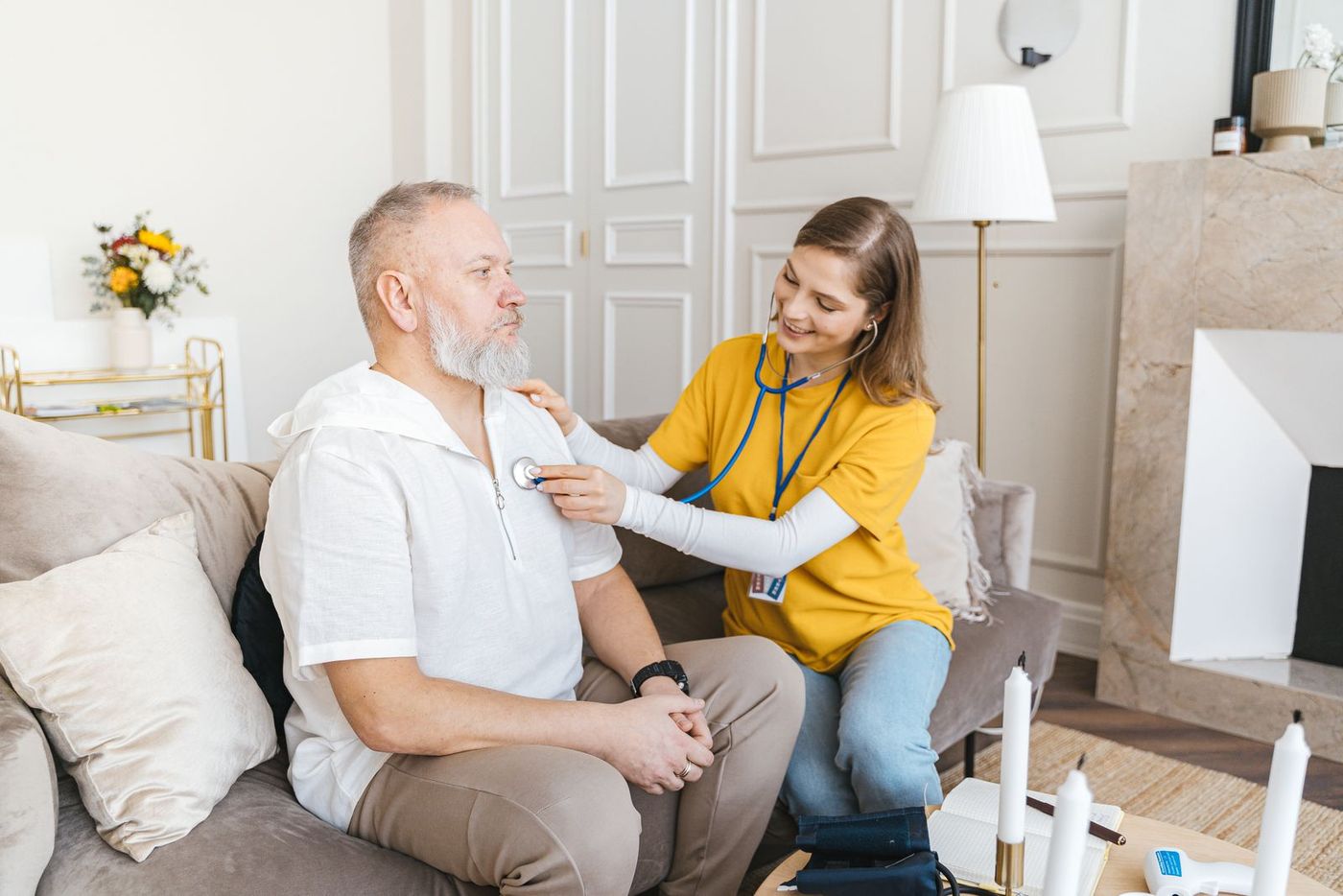
A private nurse at home is a qualified, NMC-registered nurse who delivers clinical care in a person's own home rather than in a hospital or care home. That means the sort of care a family member or a home carer cannot safely provide: wound and pressure-area care, catheter and stoma management, PEG or tube feeding, injections, and support at the end of life. It is care with a clinical hand on it, in the place people most want to be.
If you have reached this page, someone you love probably has a health need that has moved beyond everyday support. Perhaps a hospital team has mentioned a feeding tube or a catheter, or a district nurse cannot visit as often as you would like, or you simply want the reassurance of a nurse who knows the person well. This guide explains what private nursing at home covers, how it differs from home care, what it costs, how NHS funding works and how to arrange it safely. At Protocol Healthcare Services we have provided nursing and care across London and the South Coast for around a decade, and we have written this to be genuinely useful whatever you decide to do next.
What is a private nurse at home?
A private nurse at home is a registered nurse you arrange privately, or through an agency, to provide clinical care in someone's own home. They hold a nursing qualification and current registration with the Nursing and Midwifery Council, and they carry out tasks that require clinical judgement and training, working alongside the person's GP, hospital team and community services.
People choose private nursing for different reasons. Some want more continuity than a busy district nursing service can offer, seeing the same nurse who understands the whole picture. Some are recovering from major surgery and want skilled eyes on their recovery at home. Others are living with a long-term or life-limiting condition and want to stay at home rather than move into a nursing home. In every case the goal is the same: safe, dignified clinical care without leaving familiar surroundings. You can see the range of clinical support we provide on our private nurse at home page.
Private nurse vs a home carer: what is the difference?
The simplest distinction is training and remit. A home carer supports daily living and is not a registered clinician; a private nurse is on the NMC register and can carry out clinical procedures. Carers help someone live well day to day, while nurses manage health needs that carry real risk if they go wrong. Many families use both, and the two roles work best together.
The table below sets out the practical differences.
| Consideration | Home carer | Private nurse (RN) |
|---|---|---|
| Registration | Not a registered clinician; trained to the Care Certificate standard | Registered with the Nursing and Midwifery Council |
| Typical tasks | Washing, dressing, meals, medication prompts, mobility, companionship | Wound care, catheter and stoma care, PEG feeding, injections, clinical assessment |
| Clinical judgement | Reports changes and escalates concerns | Assesses, plans and adjusts clinical care |
| Cost basis | Lower hourly or weekly rate | Higher, reflecting clinical skill and registration |
In practice the line is not always neat. Some tasks, such as giving certain medications, can be delegated by a nurse to a trained carer under a clear plan and supervision. A good provider assesses honestly and puts the right person on each task, which usually means carers for daily support and a nurse for the clinical elements. That mix keeps care both safe and affordable, rather than paying nursing rates for help that a well-trained carer can give. If day-to-day support is the main need, our guide to home care in the UK is a good place to start.
What can a private nurse do at home?
A private nurse can carry out most of the clinical care once associated only with hospitals. That includes wound and pressure-ulcer care, catheter and stoma management, tube feeding, injections and infusions, medication management, and symptom control at the end of life. The exact scope depends on the nurse's training and the care plan agreed with the person's medical team.
Common clinical tasks a nurse provides at home include:
- Wound and tissue care: dressing surgical wounds, leg ulcers and pressure sores, and watching for signs of infection.
- Catheter care: changing, flushing and troubleshooting urinary catheters, keeping the drainage bag below bladder level, and reducing infection risk through careful hygiene and adequate fluids.
- Tube feeding: managing PEG and other feeding tubes, flushing before and after each feed, giving medication through the tube, and keeping the stoma site clean and free of overgranulation.
- Injections and infusions: insulin, anticoagulants, subcutaneous fluids and other prescribed medicines.
- Stoma and continence support: care around a colostomy or ileostomy, and continence management.
- Post-operative recovery: monitoring after surgery, wound checks and dressing changes, pain relief, watching for early signs of infection or clots, and supporting the mobility and exercises the hospital has set.
- Palliative and end-of-life care: pain and symptom management, syringe drivers and support for the family, often alongside the district nursing team and a hospice.
- Complex conditions: care for people with a tracheostomy, ventilation needs, or neurological conditions such as advanced Parkinson's or motor neurone disease.
Good nursing at home is also about coordination and record keeping. A private nurse keeps clear clinical notes, communicates with the GP, pharmacist and hospital team, and makes sure everyone involved is working from the same plan. That joined-up approach matters most at the points where things often go wrong, such as a change of medication, a discharge from hospital, or a sudden dip in health, when a single clinician who knows the whole picture can prevent confusion and keep the person safe.
Nurses also do something less visible but just as important. They assess. A trained clinical eye picks up the early signs of a chest infection, a pressure area starting to break down, or a medicine that is no longer working, and acts before a small problem becomes a hospital admission. For people living with dementia alongside a physical condition, that steady clinical oversight pairs well with the specialist support described on our dementia and specialist care page.
Are private nurses regulated, and how do you check?
Yes. Every nurse working in the UK must be registered with the Nursing and Midwifery Council, the independent regulator for nurses and midwives. Registration is a legal requirement, not an optional badge, and anyone can check it free of charge. The nurse must also follow the NMC's professional standards, known as the Code.
You can search any nurse by name or registration number on the NMC's online register to confirm they are registered and in good standing (NMC, search the register). The register shows the nurse's qualifications and whether there are any restrictions on their practice. The Code sets out what every nurse must do to keep people safe, covering competence, consent, record keeping and accountability (NMC, the Code).
Regulation does not stop with the individual nurse. Where nursing care is arranged through an agency or provider, that organisation should be registered with the relevant regulator: the Care Quality Commission (CQC) in England, Care Inspectorate Wales (CIW) in Wales, or the Regulation and Quality Improvement Authority (RQIA) in Northern Ireland. In England you can read a provider's inspection report on the CQC website before you commit (CQC, find a care service). Two simple checks, the NMC register for the nurse and the regulator's report for the provider, tell you a great deal about safety.
When do you need a private nurse rather than a carer?
You need nursing rather than care when the tasks involved carry clinical risk that only a registered nurse should manage. As a rule of thumb, if a procedure could cause harm if done wrongly, or needs clinical assessment to get right, it is nursing. Everyday help with living, however demanding, is care.
Signs that clinical nursing input may be needed include:
- A wound, pressure sore or leg ulcer that needs regular dressing and monitoring
- A urinary catheter, stoma or feeding tube that needs ongoing management
- Regular injections or infusions, such as insulin or anticoagulants
- Discharge from hospital after major surgery with clinical follow-up needed
- A life-limiting illness where symptom control and comfort are the priority
- Complex or unstable health needs that change quickly and need a nurse's judgement
None of this means choosing between a nurse and a carer. The most common and cost-effective arrangement is a small amount of nursing for the clinical tasks, wrapped around by carer support for daily life. A provider that offers both can flex the balance as someone recovers or their needs increase, so you are never paying for more than the person actually needs.
Timing matters too. Nursing needs often peak at particular moments, such as the first weeks after a hospital discharge, a change in a long-term condition, or the final stage of a life-limiting illness, then settle again. A good provider expects this and adjusts the plan rather than locking you into a fixed package. If you are unsure whether the current need is clinical or practical, ask for an honest assessment before committing to anything, and revisit it as the situation changes.
How much does a private nurse cost, and how do you pay?
Private nursing at home is charged by the hour, the shift or the week, and it costs more than standard home care because it reflects clinical training, registration and responsibility. Rates vary widely with region, the complexity of care, and whether you need daytime visits, waking nights or live-in cover. Treat any figure as a guide and always ask for a written, itemised quote.
As a broad picture, standard home care commonly falls in the region of £25 to £35 an hour. Nursing sits above that, because you are paying for clinical training, registration and the responsibility that comes with it, while live-in and complex care are usually priced as a weekly package rather than by the hour. The Homecare Association, the sector's membership body, publishes a minimum sustainable price for home care each year, set at £32.14 an hour for April 2025 to March 2026, the level it says is needed to pay staff fairly and cover employment costs (Homecare Association). Nursing rates build on that base.
Families usually meet the cost in one of three ways: paying privately, sometimes helped by benefits such as Attendance Allowance; through local authority support after a means test; or, for those with significant health needs, through NHS funding. We explain the funding routes in full on our paying for care page.
Can the NHS pay for nursing at home?
Yes, in some circumstances the NHS pays for nursing care at home, and it is worth checking before you assume you must self-fund. The main route is NHS Continuing Healthcare, which is fully funded by the NHS and, unlike social care, is not means tested. It can be delivered in a person's own home.
NHS Continuing Healthcare is a package of care arranged and funded by the NHS for adults with a significant ongoing health need, described as a "primary health need". Eligibility is decided by an assessment, not by a particular diagnosis, and where someone qualifies the NHS can fund care at home rather than only in a care home (NHS, Continuing Healthcare). It is not always easy to secure, so it helps to understand the process before you start; our guide to NHS Continuing Healthcare walks through the checklist, the full assessment and what to do if the decision goes against you.
There is also everyday nursing that the NHS already provides at home free of charge. District and community nurses visit people at home for tasks such as wound care, injections and catheter changes, referred through a GP or hospital (NHS England, adult community nursing). Many families use this NHS support and top it up with private nursing where they want more continuity, longer visits, or cover the community team cannot stretch to. For end-of-life care, charities such as Marie Curie also provide nursing and practical support at home, working alongside the NHS (Marie Curie, nursing services).
How do you arrange a private nurse at home?
Arranging a private nurse is more straightforward than most families expect. You contact a regulated provider, they assess the clinical needs, and they agree a care plan and match a suitable nurse, working with the person's GP and hospital team. If NHS or council funding might apply, that runs alongside rather than instead of choosing a provider.
The usual steps are:
- Talk it through. Describe the health needs and what a typical day looks like. A good provider will tell you honestly whether you need nursing, carer support, or a mix.
- Arrange an assessment. A nurse assesses the clinical needs at home, in coordination with the GP, hospital or district nursing team, so nothing falls through the gaps.
- Check funding. Explore whether NHS Continuing Healthcare, NHS community nursing or local authority support applies. This can run in parallel with getting care started.
- Agree a care plan. The plan sets out exactly what the nurse will do, how often, and how care will be recorded and reviewed.
- Confirm the checks. Ask to see the nurse's NMC registration and the provider's regulator report, and how the provider covers holidays and sickness.
- Start, then review. Care begins and is reviewed regularly, increasing or easing as the person recovers or their needs change.
Protocol Healthcare Services provides both nursing and hands-on care across London and the South Coast, so we can put a registered nurse and a familiar care team around the same person. We are a member of the Federation of Small Businesses (FSB) and are REC affiliated on the staffing side of our work. If you would like to talk it through, with no pressure and no jargon, get in touch and we will help you find the right way forward.